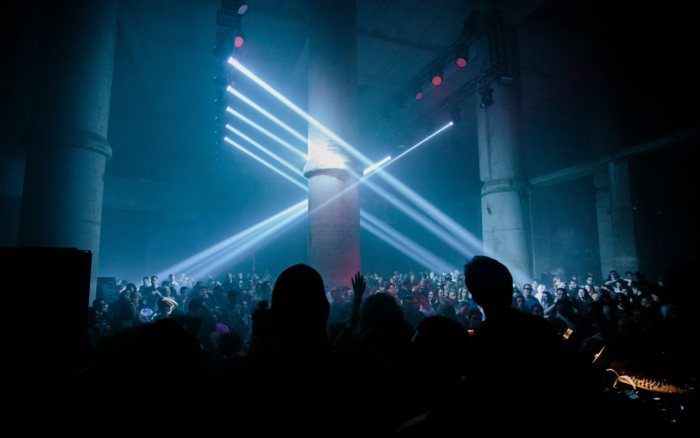
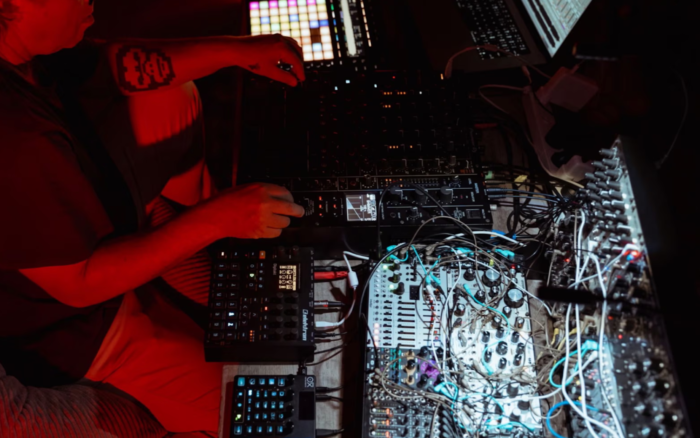
Turns out the road from Leyton runs straight through Riccione. On 11th July, Eastenderz took over Pyramid for the first time, made Cocoricò feel, for one night, like a satellite of the East End.
Every Italian kid who grew up in the 90’s had the same dream once their parents finally loosened the leash: the first proper trip to Romagna, the summer everyone older had already told you about; the discos strung along the coast between Rimini and Riccione like a rumour you finally got to check for yourself. The one everybody wanted was Cocoricò and its Pyramid, the venue where Cirillo, Ricci and Saccoman first became the kind of DJs you kept on cassette long after the tapes had any business still working. I still have a box of them somewhere.
Going back always does something to you that a new club never could, and this July it did it twice over, because on the 11th the Pyramid did something it had never done before: it handed its main room to Eastenderz for the first time. That’s not a small thing in a place that usually keeps its rooms to itself. And in a way, it still did — East End Dubs, the Di Chiara Brothers and Paco Osuna took the big stage, but the T-Room stayed exactly where it’s always been, hard techno and nothing else, run entirely in-house, and Ciao Sex kept doing what it’s always done, sex-positive, untouched by whoever’s name was on the poster outside. The club’s artistic director, Tony Mazzotta, talks about this balance almost as a discipline — building a lineup, he says, is about weaving big international names in with the formats that belong to the house, “without chasing trends” — and for once the phrase actually matched what was happening in the building.
None of it changes because none of it needs to. The pine tree is still by the terrace bar, the wall still has its parrots, the sink in Ciao Sex is still called what it’s always been called. Enrico Galli, the owner, runs the place the way a local runs something rather than the way an operator runs a venue — he’s a Romagna entrepreneur before he’s a nightclub owner, and it shows in how the town treats him back. A club this loud, this size, pulling this many people through a small seaside community every summer weekend, could easily be resented as an outsider imposing itself on the place. Cocoricò isn’t. It reads less like a business the town tolerates and more like something Riccione claims as its own, and the lines that could sound like PR turn out to hold up when you actually watch the place work. At Cocoricò, locals — not just from Riccione but from the provinces around it — pay a reduced price to get in, a policy I’ve rarely seen anywhere else, in a scene that usually just chases the tourists and calls it a night. “We like seeing our crowd enjoy themselves” is not a slogan here so much as a description, right down to two small marks on the floor that “they’ll come fix next week, they work Monday to Thursday.” Enrico has his own way of framing the years the pandemic stole from the club — a hundred people were already on the payroll, three months from opening, when everything stopped — he calls it, without irony, the luck inside the bad luck: forced into working “one corner at a time, thinking through every choice,” the place came out better for the delay than it would have without it.
The music is chosen by Tony, who moves between the club’s own productions — Galactica, Memorabilia — and the best of what Europe is putting out. Galactica in particular isn’t a mere club night anymore; it has standing residencies in Malta and Ibiza now, and when the artistic director talks about it he reaches for a specific word: community. “That’s what gives the project its identity and makes it recognisable anywhere.” It’s the kind of growth the club is happy to claim out loud — people are arriving from across Europe these days, he says, “and increasingly from other continents” — but it’s a growth that, on the 11th at least, stopped politely at the door of the rooms that matter most to the people who’ve been coming for years.
The T-room is still the bet that’s already been won. Hard techno, bounce, futuristic animations: always full, a crowd that comes to the Cocoricò specifically for that, and nothing else. As Mario Cecchini, Head of Communications of the club perfectly explains: “At Cocoricò identity is everything: one look at the crowd is enough to tell you exactly which room you’re standing in.”
With hard techno taking over the T-Room, this is where the attention to detail really becomes evident: those volumes and BPMs demand a sound system capable of carrying the intensity without losing definition, and Enrico’s answer to why it never does is disarmingly simple — “I’m passionate about it, something new comes out every so often and I improve something” — a sound this clean, without hiss or feedback, is hard to find anywhere. While East End Dubs built his set in the Pyramid with no apparent hurry to get anywhere, the T-Room stayed smaller and more habitual, full of people who know the resident promoters by name, and hadn’t come for the English name on the flyer at all.
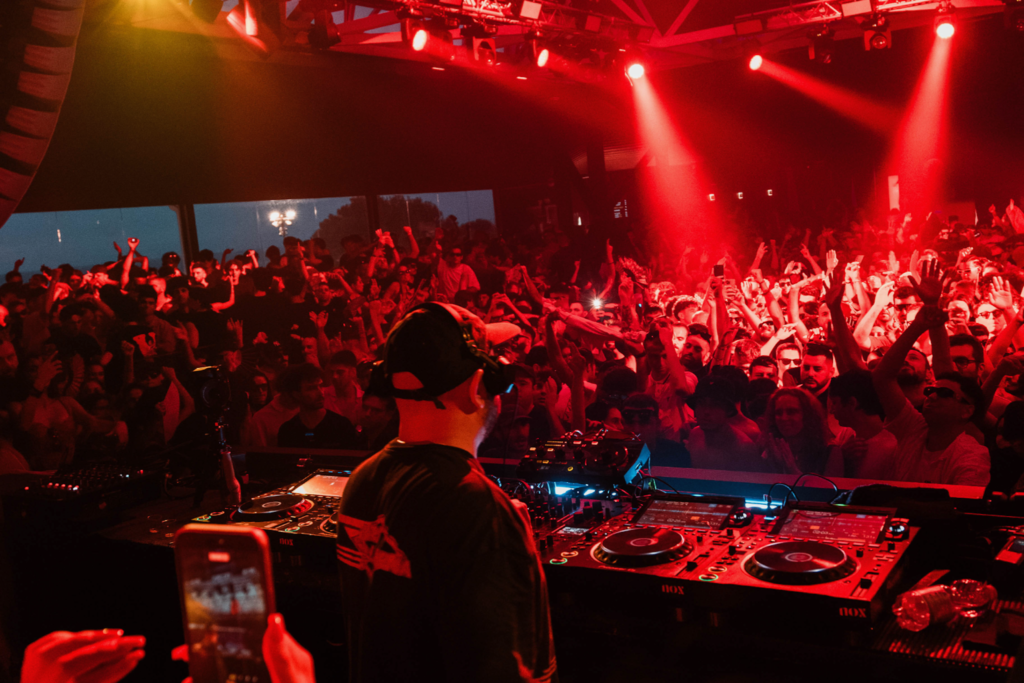
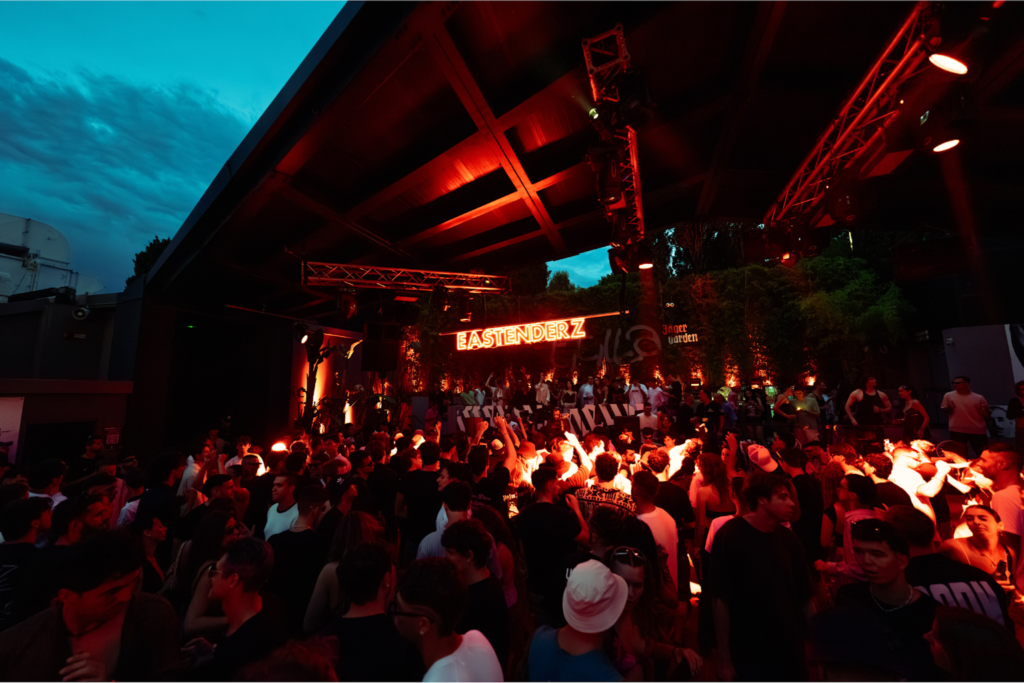
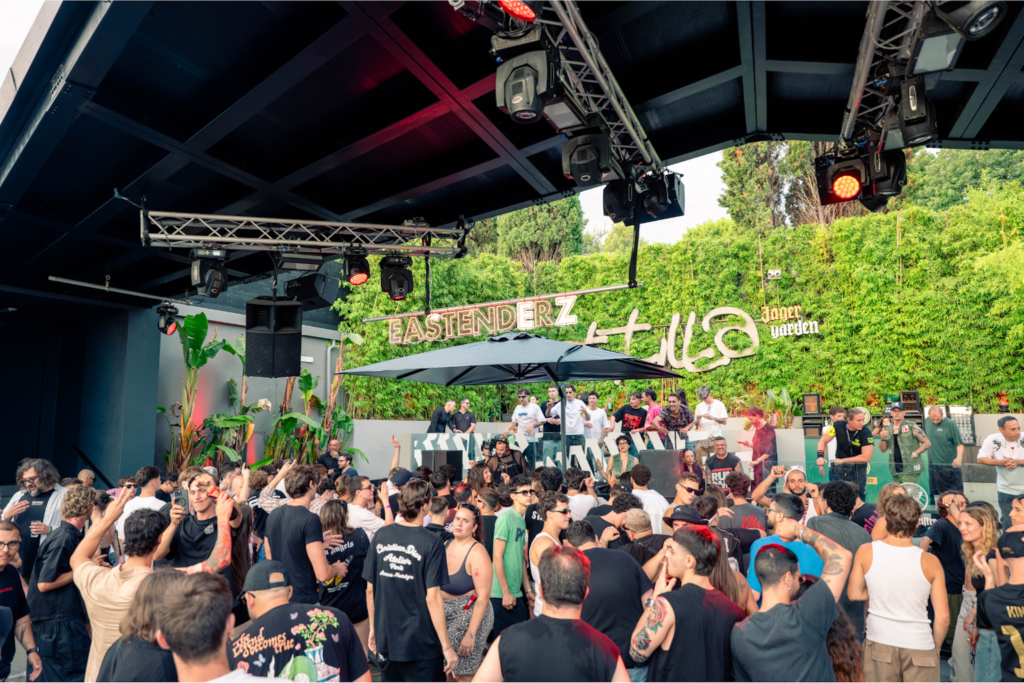
Titilla Jäger Garden is back too, refreshed, an outdoor space now dressed with plants and site-specific sculpture, and the soundproof panels the club put in for the neighbours mean the DJ can keep going “for as long as they feel like it,” according to the bartender. July heat brings its own storms, and one arrived that night between one and two in the morning, right on schedule — Titilla stayed shut, maybe if it lets up, we said, and by first light it had, everything dry. Inside, DJ and producer Idriss D was behind the decks, and the room started up with that warm, enveloping sound of hers, like being wrapped in something.
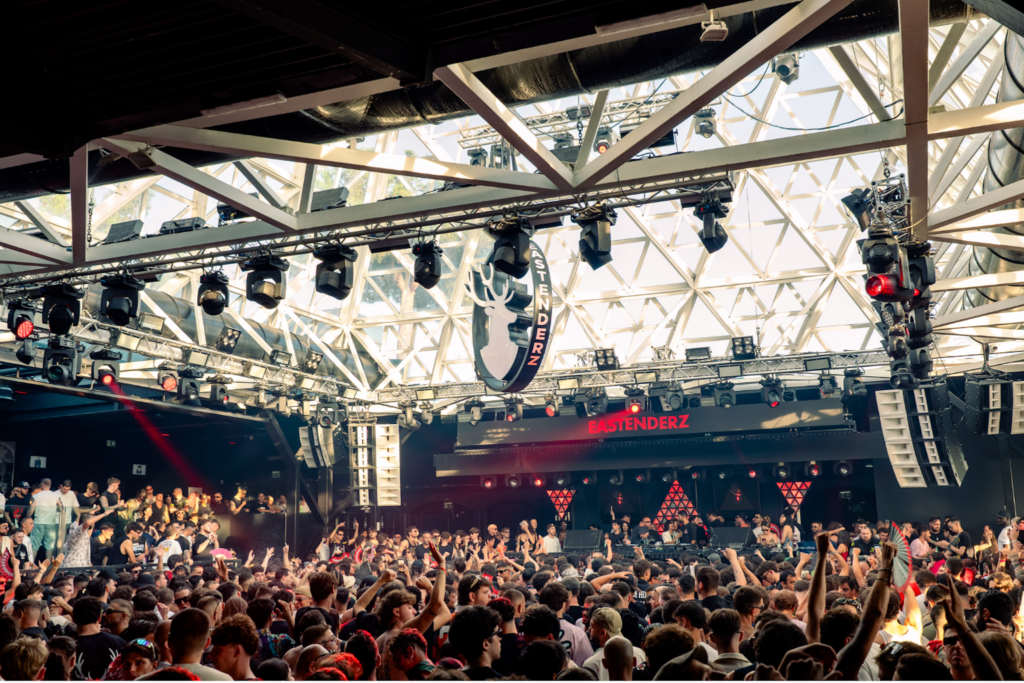
By the time the sun was high and pouring straight through the Pyramid’s glass, East End Dubs was still holding a couple of thousand people on the floor — people who used to chase down old mixtapes, curious holidaymakers, kids whose leash had just been loosened by their parents, regulars who couldn’t imagine being anywhere else on a Saturday, and this time a slice of London that hadn’t quite expected to find all of this.
The artistic director puts the shift in the audience plainly: people are “far more informed and selective” now, a big name on the poster isn’t enough on its own anymore, you have to build an identity. On the 11th, the club let a new name through the door without moving a single thing that makes it what it is — which might be exactly why, when people talk about club culture anywhere in the world, Cocoricò is still one of the first names that comes up.
Words by Claudio Morelli. Photo credits: void.rgb